This longstanding coastal club has reinvented itself, rebuilt membership and even won the Heinke Trophy for its efforts. Interview by Kristina Pedder.
When was the club formed?
Aberdeen Sub Aqua Club, BSAC branch number 67, was set up in 1958 some five years after BSAC itself.
It’s good to hear from a club set up in the early years of scuba, how is club life?
Well, we’ve had to work hard in recent years. Numbers reached a record low of just nine diving members in 2019, with no Training Officer in post and less than £1,000 in the bank.
If you were at the BSAC Diving Conference in 2024 you might have heard some of our subsequent story. Chairman Jim Burke went on stage to describe how we were motivated to write a strategy focusing on improving culture and diversity, and then how we implemented it, leading to a more welcoming atmosphere. Now there are more than 100 members, a fresh training offer delivered by a team of more than 20 instructors, and we are financially healthy.
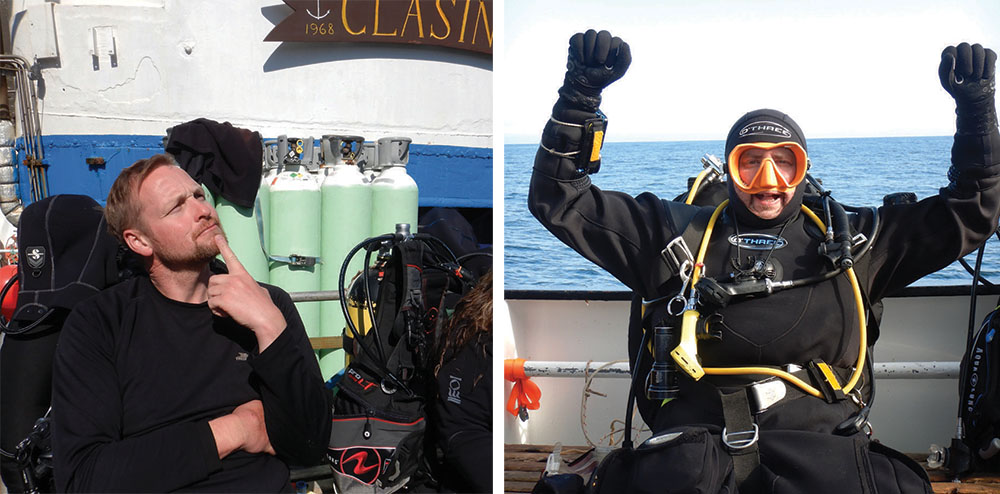
Lee Chapman ponders big diving questions | Ollie Burke celebrates a training dive
Who are your members now?
We have 130 diving members, three honorary members and three social members. Our members range in age from 12 to 70+. Around 40% of our membership and committee are women. Sixty per cent are younger than 39. We have 11 members under 18.
We have a growing number of members who are not local to Aberdeen, or even Scotland, but have joined us for the diving and training opportunities we provide and because they like the club vibe.
Did you need to increase your fees in the bad times?
No. We kept our annual club membership fee the same for seven years to keep the cost of diving affordable for members. We offer discounts for students, under18s and families. If we need money for big purchases, such as our RIB, we go out and fundraise with second-hand kit sales, cake bakes, and try dives.
For example, in the past year we ran 120 individual try dives. The club has more boats, more compressors, more kit and all for the same annual membership fee.
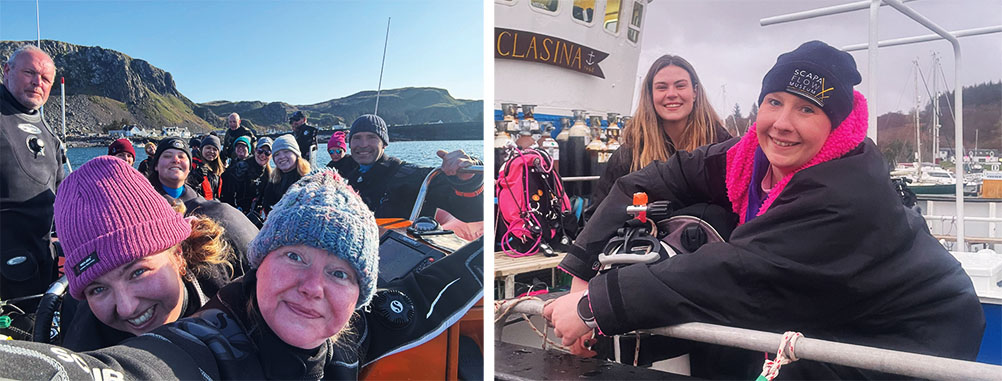
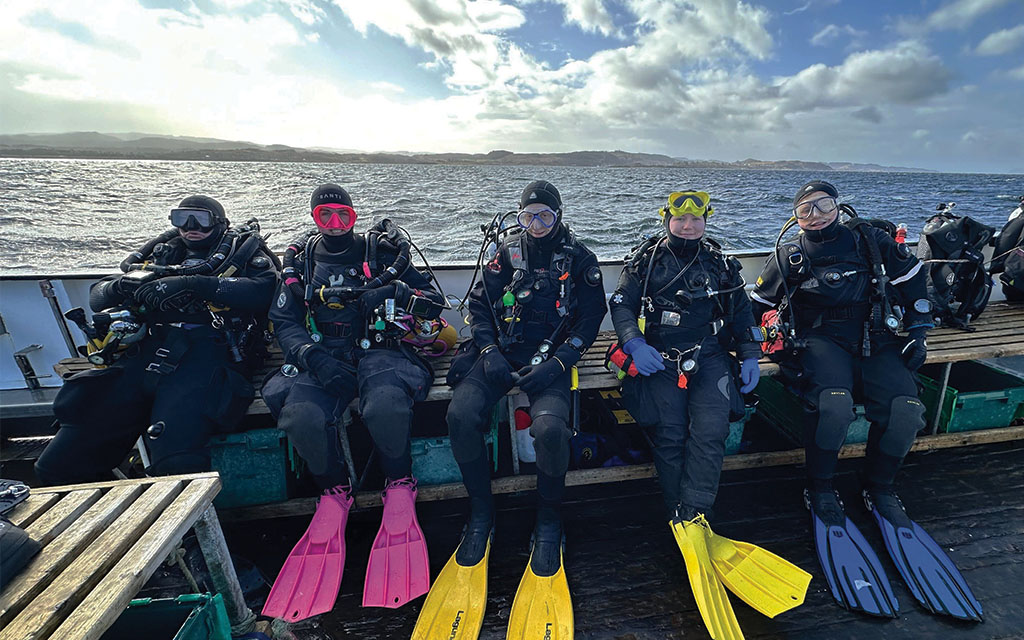
18 experienced divers ready to explore The Garvellachs | Iona Garland and Donna Sunley prepping for a training trip
What does the spread of diving experience look like?
Among the divers are three First Class Divers, seven Advanced Divers, 22 Dive Leaders, 26 Sports Divers, 46 Ocean Divers and 20 divers in training.
That’s a lot of less experienced divers. How do you manage to give them all the experience they need to progress?
The club has a strong policy of inclusion regardless of background, age, gender or ability. We do not have cliques or private dives: a club dive or dive trip is open to everyone in the club, provided they are suitably qualified for the event. We organise trips specifically designed for novice diver training and experience. We do, however, find it difficult to offer depth progression locally, our coastline is too shallow. We also sometimes struggle to get pool access for large-scale training events such as instructor training.
We have very low drop-out rates now. If people leave us, it is because they are giving up diving or leaving the area; and, actually, many stay with us despite moving away.
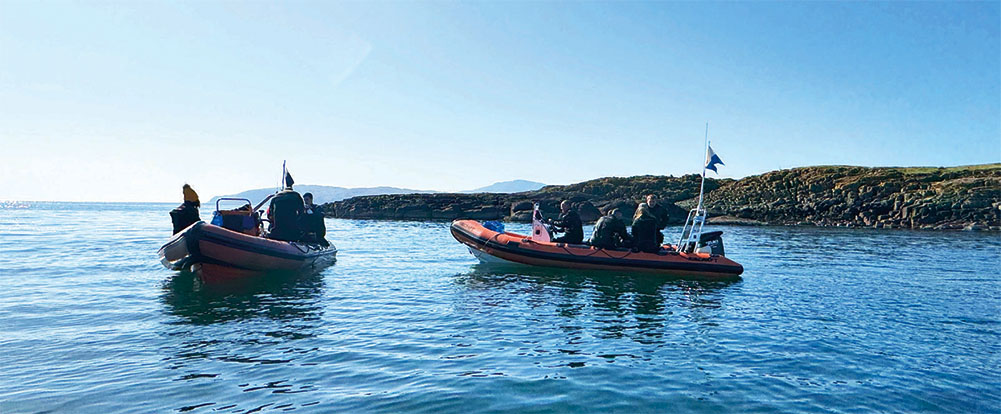
Full boats at Bach Island, annual Oban trip
Where do you meet?
Once a month we use a private venue that can accommodate about 100 people, where we can deliver lectures and some practical training including Skill Development Courses and basic life support training. We also have a monthly two-hour pool session for training, try dives and general use by club members and their families.
The new generation of planners and organisers has set up a system of training in winter, from one October intake, plus an increasing amount of interesting diving in summer, supported by some back-office improvements.
What back-office changes did you make?
We are digital first and paperless to support the environment. We have a strong focus on technology to support club operations. We make use of many freely available IT services to enhance our communication, training and logistics.
We have built an ABSAC App which works on all mobile platforms and has useful forms, guides and checklists (for example, a boat launching and recovery checklist) that all club members can access.
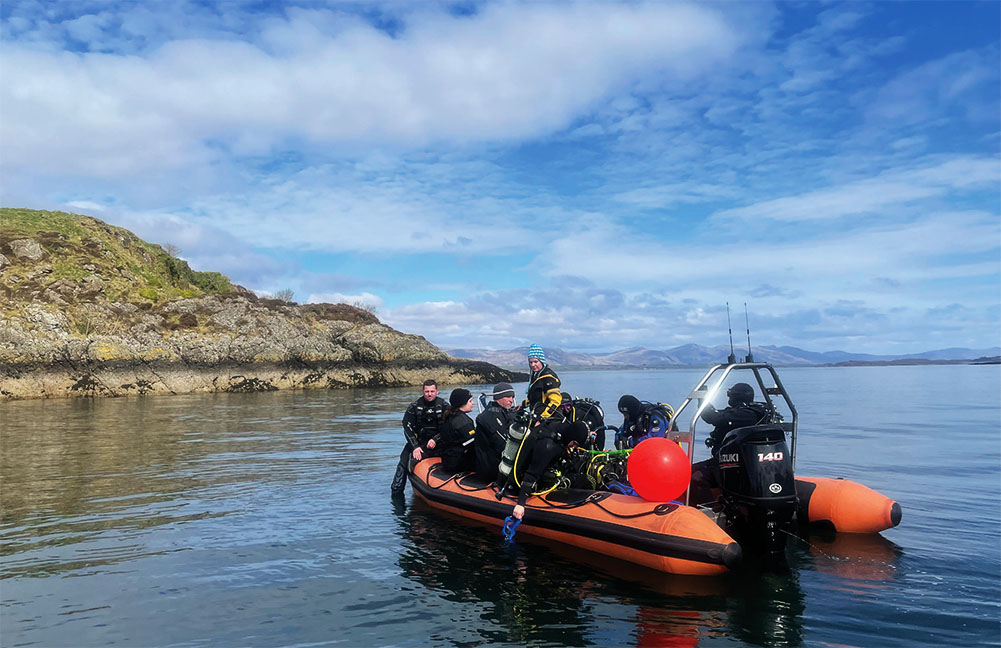
Enjoying perfect conditions on the annual Oban trip
Let’s talk about going diving.
Members dive all year round. In winter we dive in a local granite quarry when the weather is bad (which is pretty much from September to March). In summer we dive on the local Aberdeen coastline and the Moray coast, which is a 45-minute drive away. We do shore dives and RIB dives; in total, members logged more than 2,000 dives in the past year.
Ah, you have a club boat.
The club has a 5.8m RIB, bought within the past year, and a 4m inflatable; also, three of our members have their own RIBs. Our RIB is moored in a local harbour over summer to make it more available to members and reduce reliance on people towing, but we purchase a regional slip pass to use throughout our area. We also have two compressors, which are portable, and we have 16 full sets of equipment that new members can use while they are building up their own kit.
Where do you go?
As well as diving locally, in the last year we had 11 club-organised dive trips to other parts of Scotland for weekends, long weekends, weeks and fortnights. By July, we had already been to Lochaline, Oban (twice), St Kilda, the Sound of Mull, and the Inner Hebrides. During our main club training trip to Oban, we had 36 divers, three RIBs and we hired a hardboat for some of the days.
Over the past couple of years, we have used this trip to give our Advanced Diver candidates an opportunity to get their expedition planning practical done.
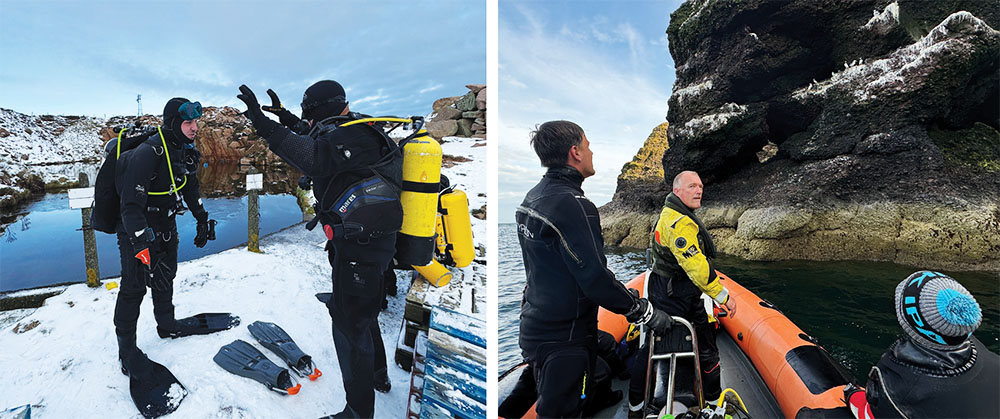
George Irvine-Sisk and Ollie Burke at the granite quarry (left)
Paul Haynes, George Irvine-Sisk and Heather Todd under the cliffs near Stonehaven (right)
Do you go further afield?
We do leave Scotland sometimes. Our annual trip to Capernwray is a great favourite, especially for the under-18s. We organised a small group trip to Malta in 2024 for eight divers, and have our sights set higher for 2026. In January, 24 of us are off to the Red Sea and have chartered a boat for the week.
What is your local diving like?
We have a very exposed coastline, so it’s all weather dependent. We have great cliff and reef diving with clear waters (up to 20m viz) and not too deep (typically 15-20m maximum). There are many sea caves to explore and beautiful underwater arches.
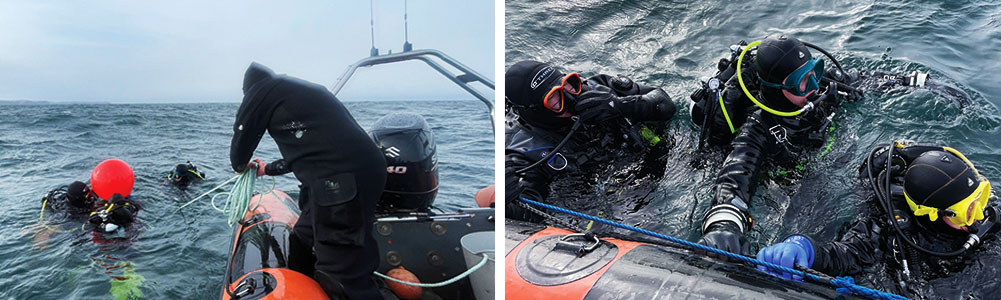
Getting to the shot, local wreck dive | Returning to the RIB
What life do you see?
The sea life is varied, lots of soft corals, anemones, crustaceans, fish and nudibranchs. We frequently see seals; and dolphins often pass by. We have seen orca, and basking sharks are becoming more frequent visitors.
There’s a great variety of seabirds; puffins, razorbills, gannets, cormorants are common and there are frequent underwater sightings of guillemots chasing the huge shoals of sand eels that visit in summer.
Most members carry goodie bags to collect any litter and fishing tackle found on dives. The tackle is donated to local anglers to be reused or melted down and used for club weights. We also seek out trapped and lost lobster pots which, if we cannot free and return to the owners, we ensure are disabled.
Any wreck diving?
Members have found and documented nearly 60 shipwrecks in 25 years. Offshore, there are literally hundreds, but they are deep and only dived by the club’s small but growing group of technical divers. There are some shallower wrecks, but they are broken up by the huge seas on our exposed coast.
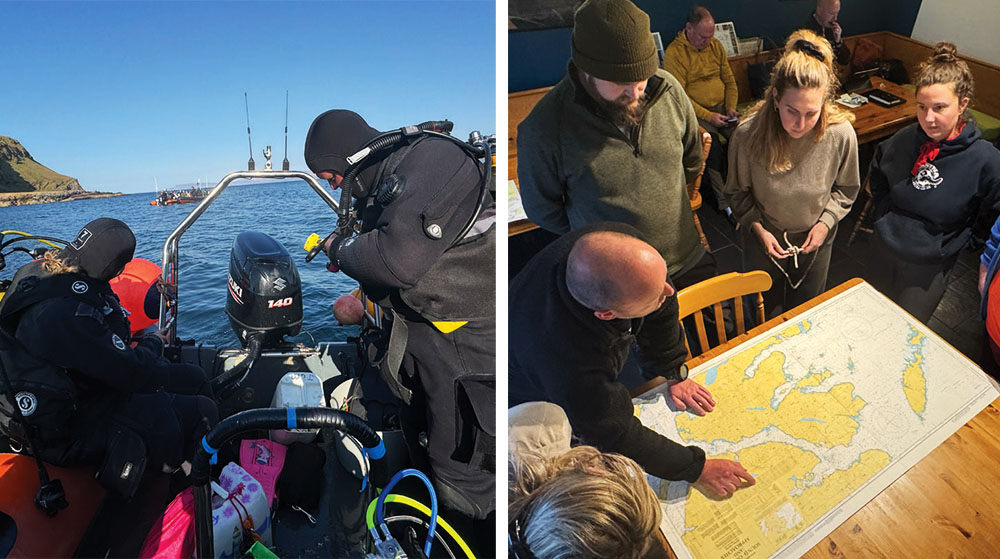
Rachael Green and Jim Burke at The Garvellachs | Impromptu chartwork SDC (right)
What does your training schedule look like?
We typically have 12-16 Ocean Diver trainees per year. We run dedicated training trips where instructors focus on taking members to their next level of certification. We have already booked up a week-long trip in March to put 32 OD, SD and DL candidates through their training. We provide free drysuit training to the many overseas-trained divers who join us as wetsuit divers.
We also run club SDCs and in the past year have put 23 members through boat handling and 17 through Chartwork and Position Fixing courses. We also help our local university club with training; in common with many student clubs, they struggle for instructors.
Tell us about your instructor team
We have a National Instructor, 12 Open Water Instructors, two Assistant Open Water Instructors, and 14 Assistant Diving Instructors. We hosted a local Instructor Foundation Course in May, which six of our members attended. Despite the growing team, aligning instructor availability with trainee availability and weather remains complex.
And finally, what is the club planning for the next few years?
We want to grow our instructor base and continue to offer training and diving opportunities to anyone wanting to explore the underwater world. If funds allow, we would like to purchase a second RIB. We want to actively encourage under-18s to join us and build their experience and confidence.
We see great value in collaborating with other clubs, so we’ll continue to support other clubs using our facilities; we are always keen to help anyone who asks. Ultimately, we want to do more expeditions to exciting dive locations and are looking at potential trips to Rockall, the Coryvreckan whirlpool, Chuuk Lagoon, the Solomon Islands, Socorro Island and the Philippines.
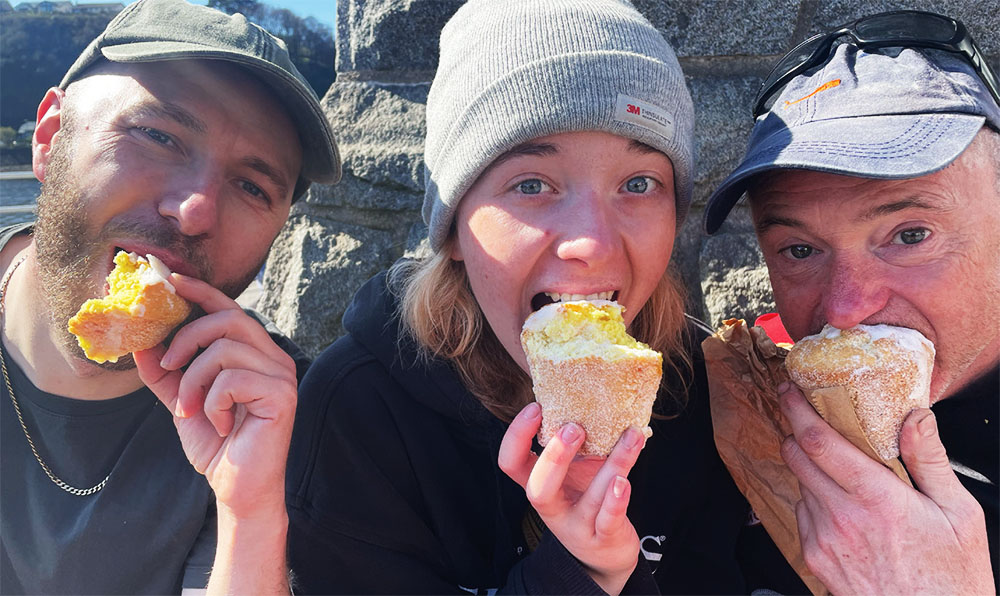
Doug Blake, Hannah Johnson and Keith Williams enjoy post-dive snacks
This article was originally published in SCUBA magazine, Issue 159, October 2025. For more membership benefits, visit bsac.com/benefits.
Images in this online version may have been substituted from the original images in SCUBA magazine due to usage rights.