In 2025, Castlereagh Sub Aqua Club in Northern Ireland celebrated 50 years. Current members spoke to Kristina Pedder.
LOCATION: Northern Ireland
MEMBERSHIP FEE: £264 (concessions £132) plus BSAC
CONTACT: See website
This busy, innovative branch has come to be known for its welcoming and friendly environment; an ethos members are keen to carry forward into the future. The club hosted a celebratory dinner at the Ivanhoe Hotel in September to mark the event and launched a documentary made for the occasion that celebrates the highlights of those first 50 years on the club’s YouTube channel. I wanted to find out more about life at the club today.
Tell us about Castlereagh’s club history
Castlereagh Sub Aqua Club (CSAC), on the outskirts of Belfast, was formed in September 1975. In 1976, the club joined BSAC. From a nucleus of 10 or so founding members, the club is now 51 years old, and has around 70 members. In 1985, members discovered two Elizabeth I era cannons off the County Antrim coast, near the town of Larne. The cannons were eventually auctioned in London and purchased for the equivalent of £45,000 in today's money by the Ulster Museum. The proceeds of sale were used to help purchase our current club rooms and three small inflatable boats and engines.
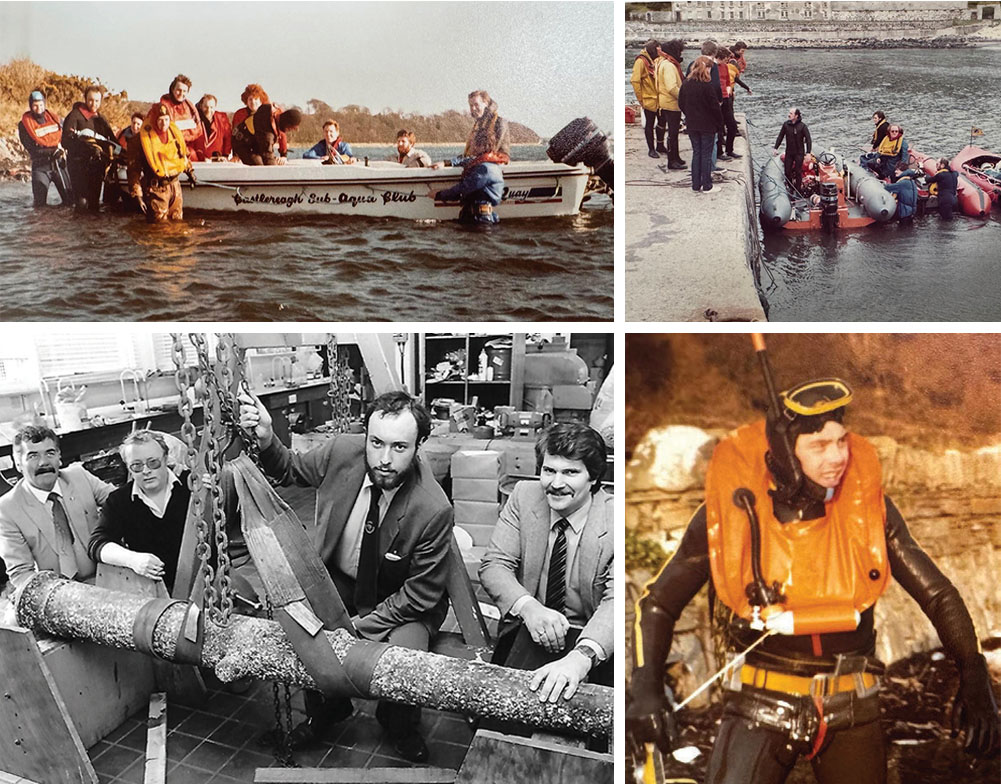
Clockwise: Castlereagh’s new Dory, 1984 | Rathlin Island harbour, 1980s |
Typical 1970/1980s dress code | Members Billy Brown, Ralph McBride,
David Cunningham, Randal Armstrong in Ulster Museum
Where are you based?
Our club house is on the Castlereagh Road in Belfast. Despite being in a built-up urban area, the club attracts members from across Northern Ireland. We train, socialise and meet there to organise many of the interesting dives that are easily accessed by land or boat across Ireland.
Who are your members?
Members come from across the social, professional and age spectra. Our youngest and only youth member is 14; on the other hand, we have active divers in their 70s who make the most of their spare time by participating in many club dives and bring their extensive experience with them.
We have three trainee members, 10 Ocean Divers, 22 Sports Divers, 19 Dive Leaders, 13 Advanced Divers and two First Class Divers. The majority (62) signalled intent to participate in diving during the year ranging from twice weekly to once or twice a year. The rest no longer dive but enjoy being part of the club.
I hear the club is well known in the region as a training branch.
Training is a key aspect of club life. Most members play a role in the training delivered every year. They are more than happy to support by arranging kit, acting as buddies, catering for dive weekends, and assisting with boat or shore cover.
We usually experience a lot of interest in our try dives, which we offer once a week at no cost during the month of October. We often end up with more demand for training than we can cater for. We try to keep to a maximum limit of 10 new Ocean Diver trainees per year so that instructors can comfortably deliver while continuing to support current members’ progress through their diving grades.
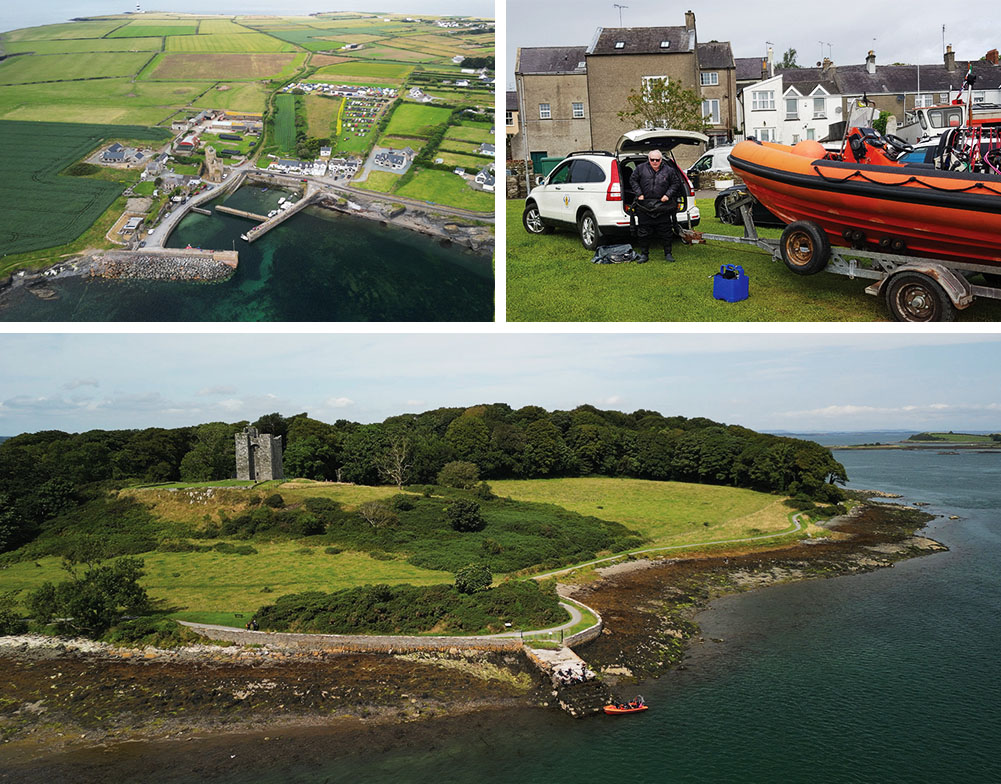
Clockwise: Hook Head Dive Rally, Wexford, Ireland 2024 | Ralph McBride, DO, Strangford town
with new club car | Members enjoying a picnic by Audley’s Castle, Strangford
What courses do you deliver?
This year we had four newly qualified Ocean Divers, while 12 members progressed to Sports Diver. We also held a training weekend in August to progress Dive Leader training for four members.
Over the past 12 months we have had members complete Skill Development Courses including: Boat Handling, Diver Coxswain, Oxygen Administration, Compressor Operation, Marine Life Appreciation, Search & Recovery, Chartwork & Position Fixing, Automated External Defibrillator, Buoyancy & Trim Workshop, First Aid for Divers and Practical Rescue Management.
What does your training team look like?
Our current Training Officer, Craig Cameron, took over from Ralph McBride, who passed the regulator over after 40 years of delivering excellent training to all our members. The team includes one Advanced Instructor Trainer, three Advanced Instructors, eight Open Water Instructors and six Assistant Instructors. The team is very passionate and proud about passing their knowledge and skills of our sport onto a diverse mix of members year after year.
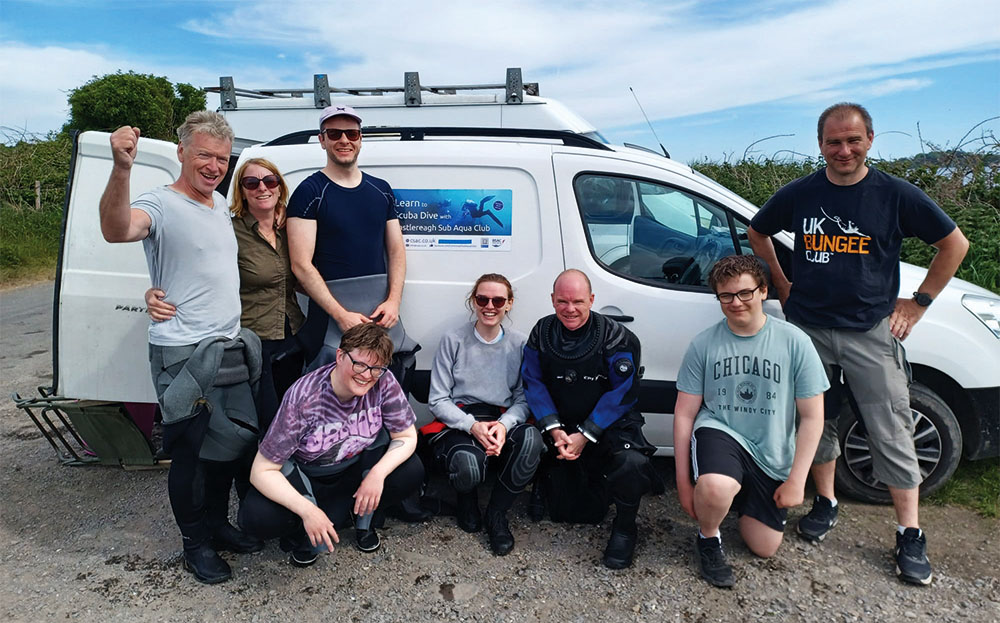
Craig Cameron (kneeling centre) with newly qualified Sports Divers
Where does basic training take place?
Initial training for Ocean Divers lasts about 12 weeks and is carried out at Lisnasharragh Leisure Centre, which has a diving pool that can be set at various depths down to 3.8m. We tend to hold open-water training at a site on Strangford Lough known locally as the Inner Lees, a wreck site giving depths between 5m and 12m.
This is an easily accessed shore dive leading to the wreck of the Empire Tana, a Second World War Liberty ship, which also acted as part of the Mulberry harbour at the landing beaches in Normandy. During the 1940s she struck a reef in Strangford Lough and has since broken into two (the Inner and Outer Lees). The Inner Lees is a great training site because it allows for skills to be tested in a reasonably controlled open water area.
In June 2024 several of our members marked the 80th Anniversary of D-day by laying a wreath at the site.
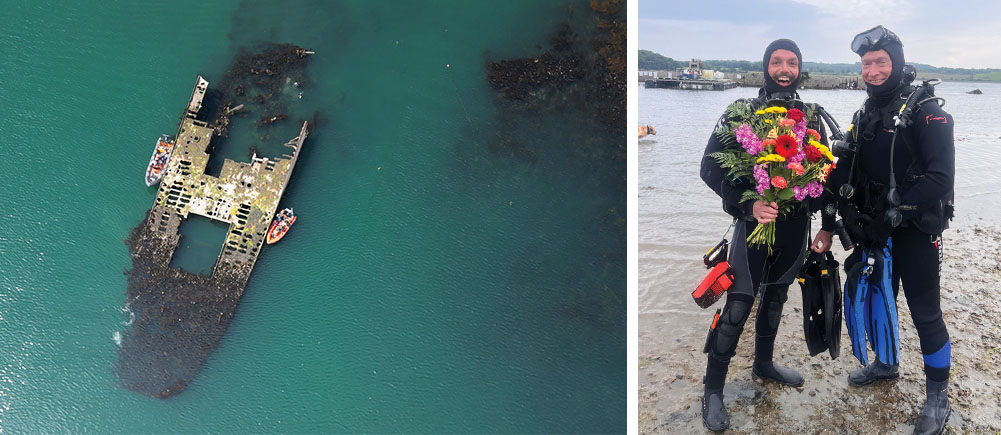
Left: Club Dive on Empire Tana (aka Outer Lees), Portaferry
Right: Tim Boyd and Dale Aiken, D-Day commemoration, Empire Tana
When is the local dive season?
Most of our diving takes place between March and October, so we can revisit sites throughout the season and witness the sea life flourishing as the water warms up. It is possible to dive all year round in the waters of Northern Ireland, but the weather is regularly a challenge. It can be unpredictable and even the best laid plans can be scuppered by strong winds or rain. We overcome this by adopting a flexible approach, especially to our training where we have back up plans in place to ensure that if plan A does not work out, we can always adopt plan B.
Where do you dive?
We are fortunate to live on a relatively small island, with easy access to a wide range of sites and more than our fair share of wrecks to explore, some as shallow as 6m. Over the summer of 2024, members attended dive rallies in Teelin, Donegal, hosted by Donegal Bay SAC and Hook Head in Wexford, hosted by Hook Head Sub Aqua Club. These were great opportunities for us to extend our knowledge of dive sites around the coast and meet divers from all over Ireland.
Tell us about some favourite sites…
There are some easy-to-access shore dives on Strangford Lough and Belfast Lough that provide handy sites for a dip in the evenings after work. The Pins in Strangford Lough just outside Portaferry, is less than an hour’s drive from Belfast. It is believed to be the wreck of SV Zarina, a Swedish Barque that sank in the 1700s. It is referred to locally as ‘The Pins’ because of the copper or brass bolts and pins that can be seen.
A bit further afield, another popular shore dive is St John’s Point, a headland in County Donegal, around a two-hour drive from Belfast.
In September, we tend to hold a weekend of diving at Rathlin Island, just off the coast of Ballycastle. Here, we are spoilt for choice with dives including SS Lochgarry, a ferry that saw service in the Second World War, which sank during a massive storm in January 1942 while transporting troops from Oban to the Faroe Islands. She sits upright at about 32m and is largely intact with a wide variety of sea life, making this an exceptional and popular wreck with the locals and a must-dive for visitors. The Rathlin wall (80m+) is also well loved. The Templemore wreck (around 18m) and the Drake (15m) are also within a short RIB trip from Ballycastle Harbour.
Does the club own a boat?
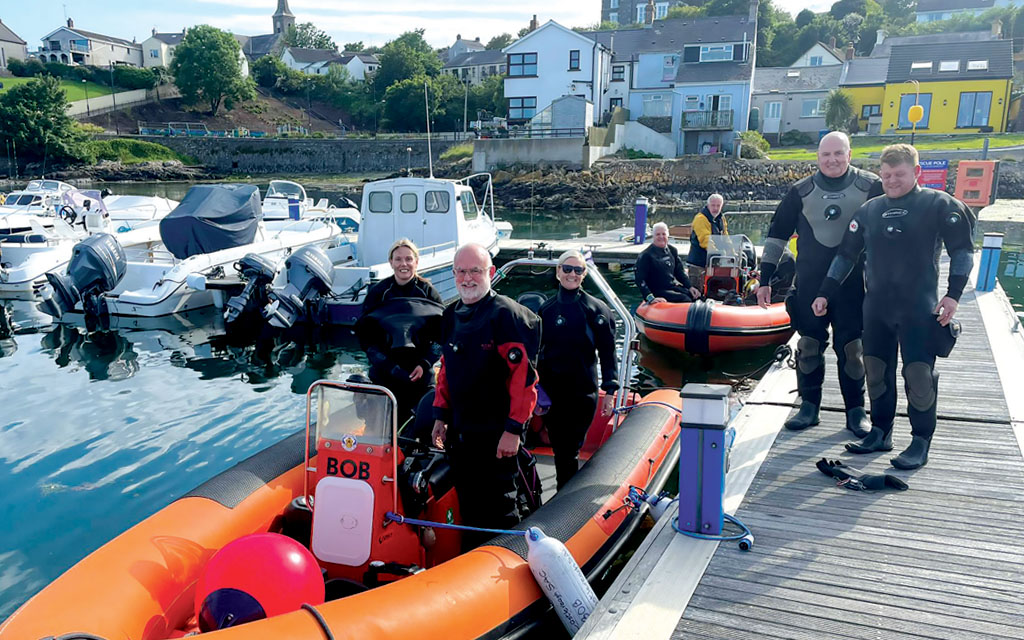
Yes, we have owned and run many boats. In addition to the boats bought using the proceeds from selling the Elizabeth 1 cannons, in 1996 we obtained a grant from the Sports Foundation for our first RIB, and in 1997 we purchased a static compressor and air bank with our first Lottery Grant. The following year we were successful with our second Lottery Grant application for a second RIB.
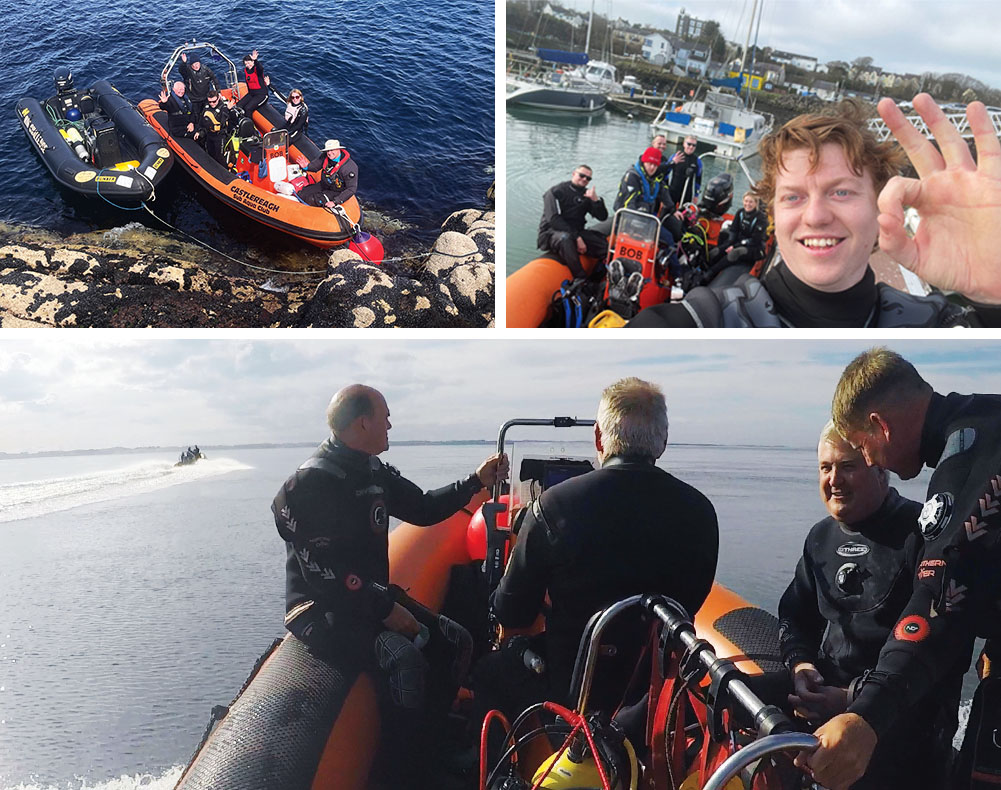
Clockwise: Dive Leader training at Clifden, west coast of Ireland |
Austyn Finnegan and other divers leaving Ardglass | Club RIBs leaving Strangford Lough
What other resources are there for members?
We purchased a club car for towing the RIBs and transporting equipment. This is a great asset to the club and saves on wear and tear on members’ vehicles. We have recently replaced our portable compressor with a much lighter, more efficient model that enables us to independently fill cylinders when at remote dive sites without having to find local operators. We also have a wide range of training equipment used mainly by trainee Ocean Divers but is also available for any member of the club to use.
How do you manage the boats?
In 2025, for the first time, we took a new approach with our two club RIBs, booking one into Bangor marina for a month to give our members access to the many dive sites in Belfast Lough. The other was booked into Ardglass marina for three months, affording access to sites in the Irish Sea and Strangford Lough. It is much easier all around, with the boats launched and ready to use. It really has been a game changer; making organising dives easier. We hope to extend this next year to other marinas.
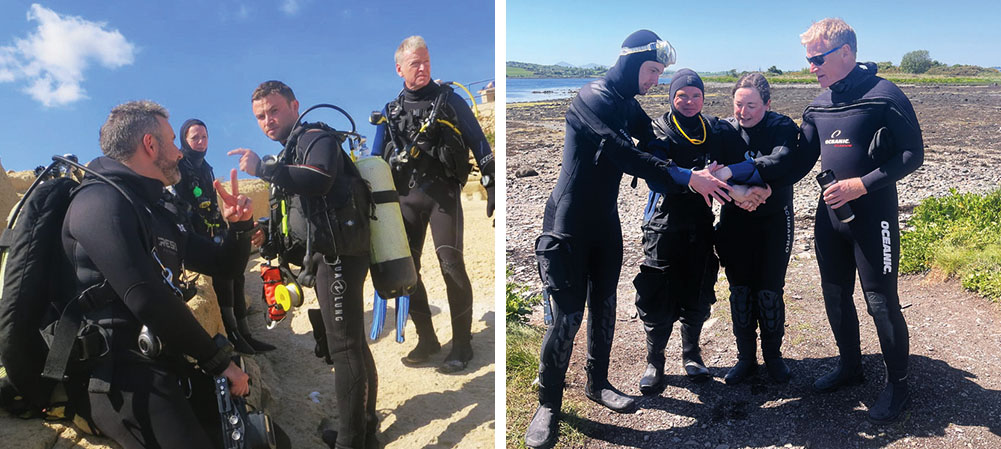
CSAC divers planning next dive in Gozo | Congratulating newly qualified Ocean Divers, Dan and Caroline
What are the plans for the future?
We are planning to establish a group to focus on fundraising to help achieve our ambitious plans for a new clubhouse. Funds are mainly raised through membership fees and boat dives and excursions. We would also like to buy new engines and secure new accommodation for the two club RIBs.
For anyone interested in knowing more about Castlereagh Sub Aqua Club, why not watch our anniversary video or contact us via our Facebook page or email. We look forward to hearing from you.
Become a BSAC member
Want to scuba dive, make friends and have adventures? You can join a club like this one near you!
To get started, find a club and send an enquiry.
This article was originally published in SCUBA magazine, Issue 160, November 2025. For more membership benefits, visit bsac.com/benefits.
Images in this online version may have been substituted from the original images in SCUBA magazine due to usage rights.