What’s it like being examined for BSAC’s highest instructional qualification? Alex ‘Woz’ Warzynski sets out a candidate’s perspective.
With First Class completed earlier in 2025, my next logical step was to continue to National Instructor (NI). It’s not something that you enter into lightly – the exam planned for September is really just the final part of a fairly long process to attain the expected level. For 2025, BSAC had decided to change it slightly, making the assessments for the Instructor Trainer Scheme (ITS) part of the exam ‘live’ on real events, instead of putting on simulated versions. To do this, you already have to be an ITS Coach where you develop other Instructor Trainers, a role I’d been happily doing for several years.
There are 23 elements of an NI exam, including developing divers using a Personal Development Plan, the ITS elements, teaching at short notice, teaching Advanced Instructors how to teach, and even teaching instructors how to teach other instructors how to teach. These different levels really mess with your head and it takes a fair while to get into the ‘zone’ where you can work out at which level you need to be teaching – are you instructing a diver, coaching an instructor, or teaching an instructor trainer how to coach?
To get up to speed, there are a couple of preparation events that are well worth attending, to give you plenty of practice without the pressure of the exam. The first gives you a chance to practise planning a rescue workshop, run a teaching dive, do a branch interview and a practical surface lesson at short notice. All under the guidance of experienced NI Coaches, whose job it is to nudge you in the right direction.
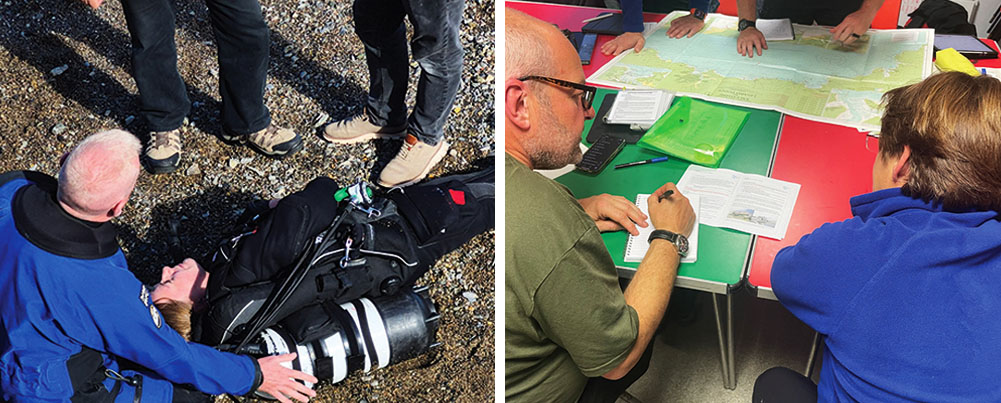
Rescue workshop in action | Task planning
The second prep event was almost a fake exam. The first day was run from a skippered hard boat developing First Class candidates; the second run from RIBs, developing Advanced Instructor candidates. Like the exam, it’s an intense couple of days where you are expected to teach (and teach how to teach) absolutely everything from making up a shot, driving boats, locating dive sites, weather, buoyage, planning, dive management… the list is endless! The nice thing about these prep events is you can work out what you then need to do for the exam, so when it comes to the actual day, you are about as well prepared as you can be.
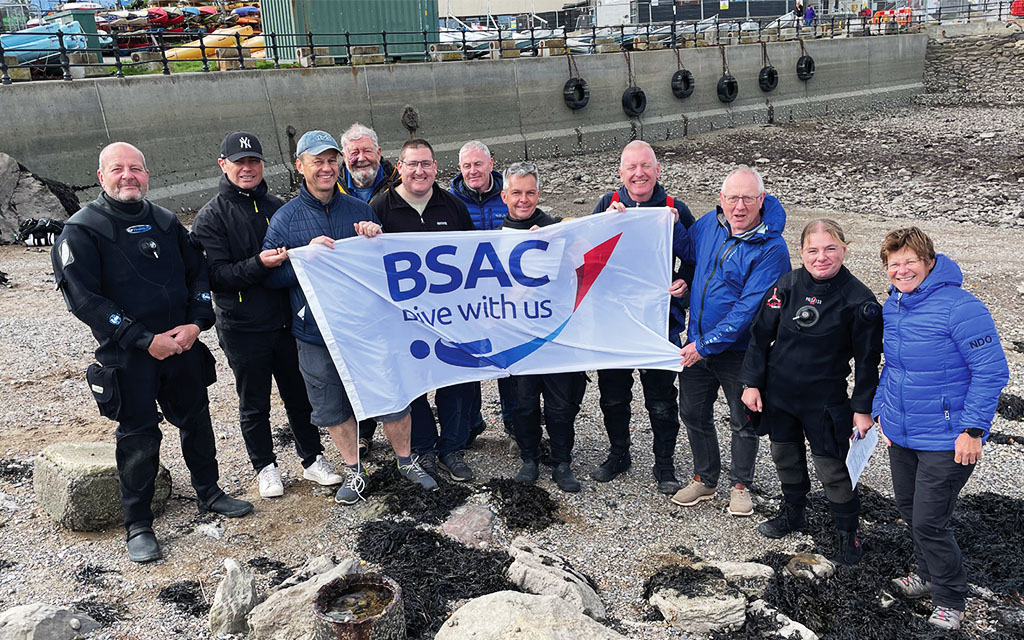
One of the best things about the 2025 event were the five candidates. We vaguely knew each other from being active on the ITS circuit, but apart from the odd IFC we hadn’t really worked together. It didn’t take long for us to form a brilliant little group, bouncing ideas off each other, offering loads of support and bringing the whole group along for the ride. One of the assessment areas is Attitude, and the five of us worked so well together we didn’t have a moment where we fell out. The examiners commented that it was one of the best groups they had seen working together.
Overcome and adapt
So what about the exam itself? The candidates rocked up to Bovisand Lodge Holiday Park on a sunny Thursday lunchtime, and all appeared to have brought every buoy, piece of rope and shot weight from home. We tipped it all out and sorted it out into a vague logical order, practising making up a lazy shot for the First Class Diver adventurous dive, and the grid task for the AI dive. We even brought whiteboards, magnetic labels, a billion pens, a laminator and printer!
At 6 pm the exam started proper at the Mountbatten Centre. We had to plan two dives for the next day. The first was an adventurous dive where we were to simulate the techniques for a deeper dive; the second a project dive to conduct a wreck survey of the stern of the James Egan Layne. To complicate this, in the 90 minutes we also had to teach how we were doing these tasks to the examiners.
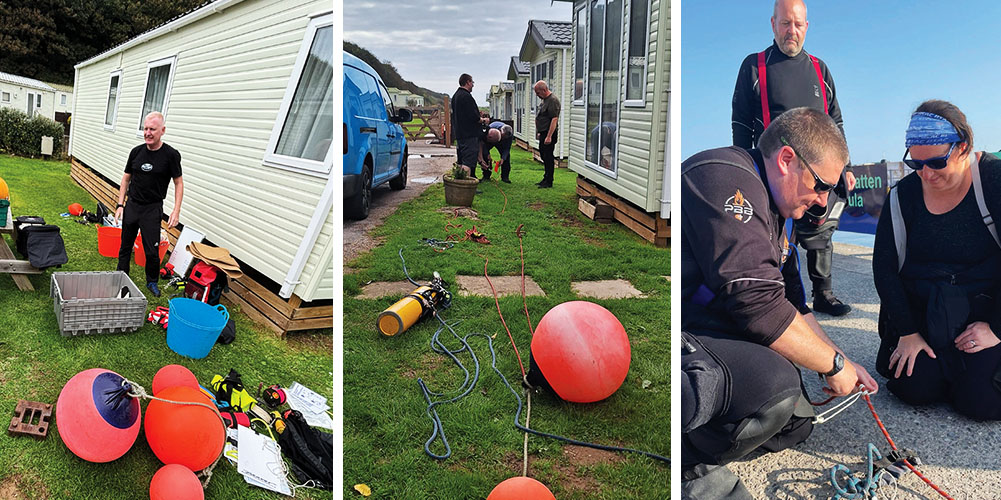
Left/Centre: Prepping the lazy shot | Right: Making the ‘lazy prussic’
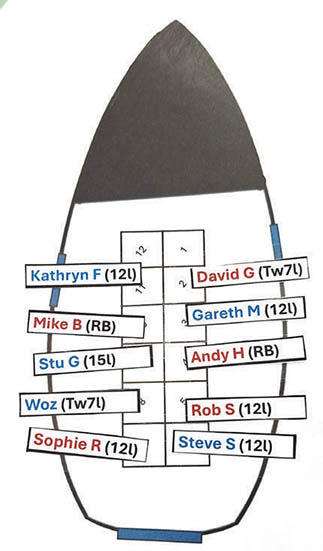
On the Friday, we headed down to Mountbatten to unload kit and lay it out ready for a dry run. At 8am we gave the day brief, then ran through (and taught) making up a lazy shot, deploying a drop tank, diver tags and strobes, then another dry run of the techniques we were to use for the second dive. Then we bundled it all up into builders’ rubble tubs and taught loading our gear onto Red Alert, to a boat seating plan we had worked out.
On the way out to the Rosehill, each candidate had to ‘ping’ a wreck to demonstrate they could position-fix. I had the Elk to ping, so showed a couple of different techniques to the examiner. I took advantage of modern bathymetric seabed data to accurately position the boat over the wreck, as the GPS marks on the chart were slightly off. The adventurous dive was good fun, copying the techniques we had practised on the dry run on a real dive, keeping to the planned dive time and collecting some data on the marine life on the wreck.
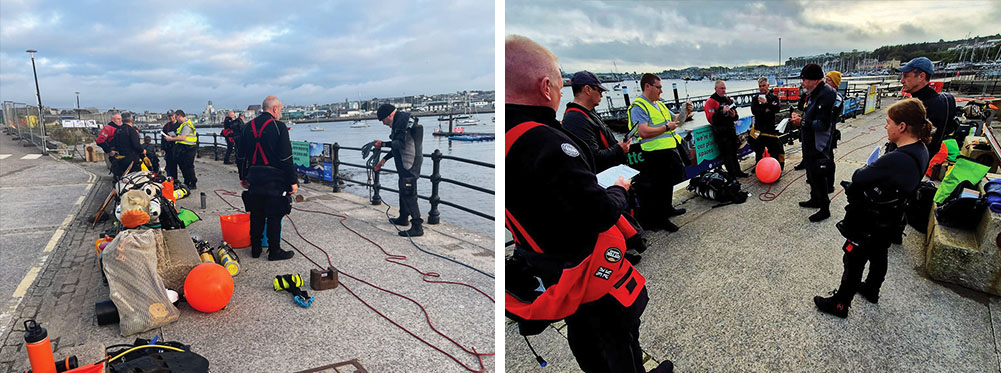
The dry run | The briefing takes place
In between dives, the candidates were continually asked questions to probe and test the extent of their knowledge, covering everything from weather to first aid, equipment and planning, all the while managing the diving, and teaching how to do so.
The second survey dive was collecting data on the condition of the stern of the James Egan Layne. Most of us had dived it in the last couple of years, but it was apparent that the stern had collapsed in on itself and was no longer standing proud of the seabed. We laid (and taught) baseline tapes and each team had a different task.
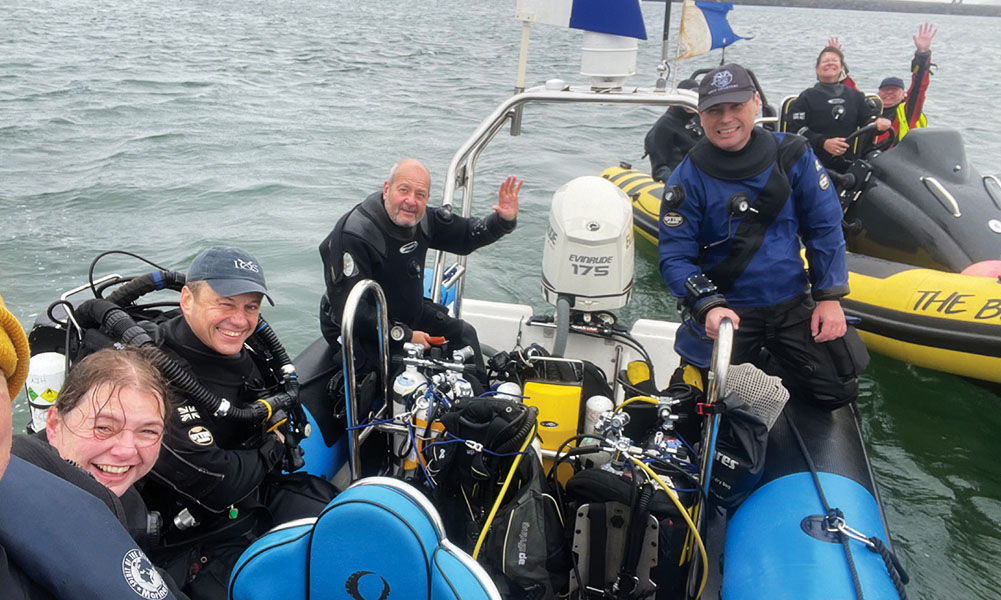
Out on the water
The dive was complicated a little when a baseline tape snapped, but ‘overcome and adapt’ was the order of the day and we came out with some useable data. More importantly, we had plenty of opportunities to teach how to collect our data. The weather, strangely for an NI event, was playing ball. Only one of us had a bit of seasickness on the way back...
Back at Mountbatten we had less than an hour to come up with a quick summary presentation – we all thought no way could we do it in that time, but amazingly we pulled it off and gave feedback on what we had collected on the dive.
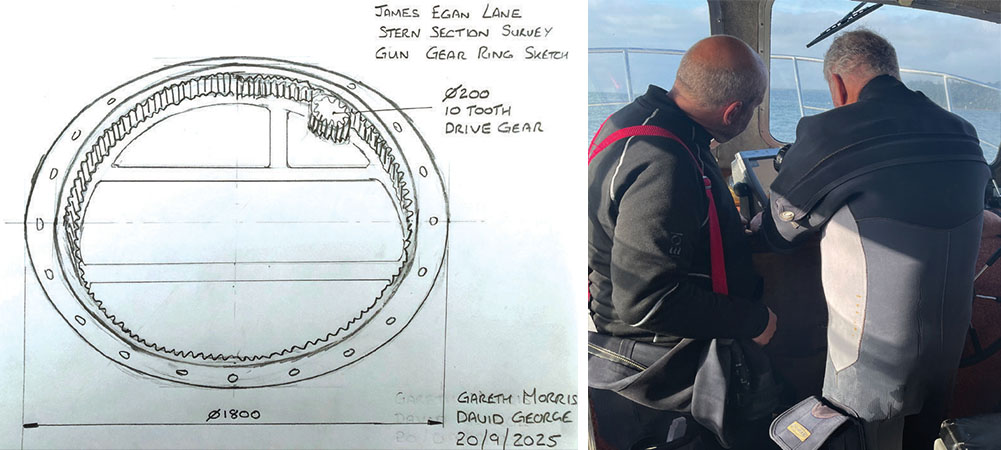
Sketch of the stern gun ring gear | Pinging the Elk
Bad news
Saturday saw us back at Mountbatten, where we split into teams to dry-run laying out a grid to conduct a marine survey on the quayside. Unfortunately, the seasick candidate still wasn’t feeling well and had to pull out, and the weather had properly closed in.
The candidates made the decision to move the dive location from the planned Glen Strathallan to inside the breakwater near the fort, as the wind had increased to a force 6 southerly which made the Glen undiveable, it being fully exposed to the wind.
Boats loaded, we headed off, taking the opportunity to teach some boat handling, and how to teach the teaching of boat handling. We all had some pre-prepared information slates. I could simply whip the slate pack out of my pocket and use the slates as a visual aid when teaching something.
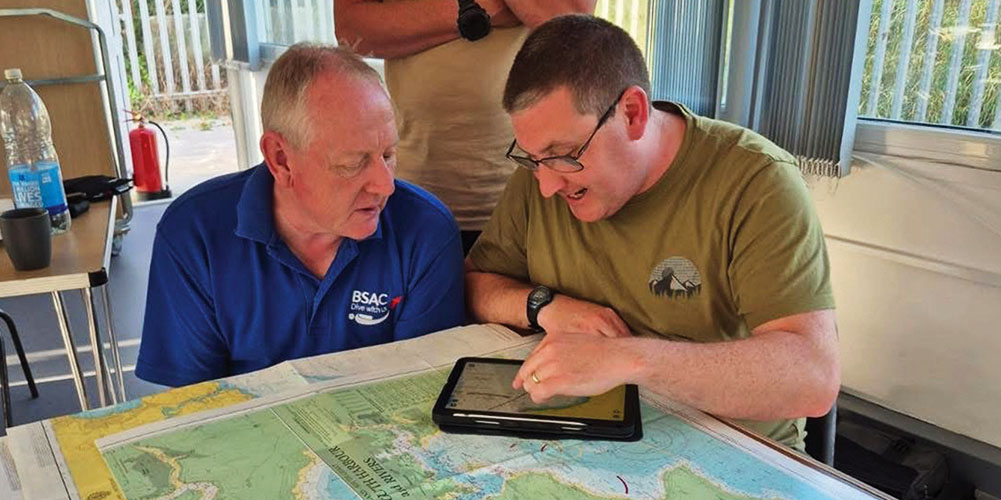
Chartwork in progress
I even had a prompt slate pre-prepared for a bubble check, as you are expected to use more advanced complimentary teaching techniques, not just demo-mimic. Plus you can hand the slates over to the examiners and ask them to teach it back to you, which gives you a break from the incessant questioning!
My examiner had a new camera with a macro lens, so we discussed what skills were relevant and worked out a few simple things to teach on the dive, from back-finning to advanced, fine buoyancy control. We also planned to teach torch communication, and laid a line to practise using zero viz touch signals, a technique used in cave diving, and something that would surprisingly come in useful on dive two!
The surface interval was again full of more questions and teaching, although at one point I had to ask the examiner to pause for a minute so I could shove a sandwich into my face.
The wind had, as forecast, picked up from the west, so the choice of Cawsand Bay was a wise one, it being well sheltered. We had a brief discussion about getting back to Mountbatten, and worked out a quick alternative passage plan that involved hugging the coast to minimise our exposure.
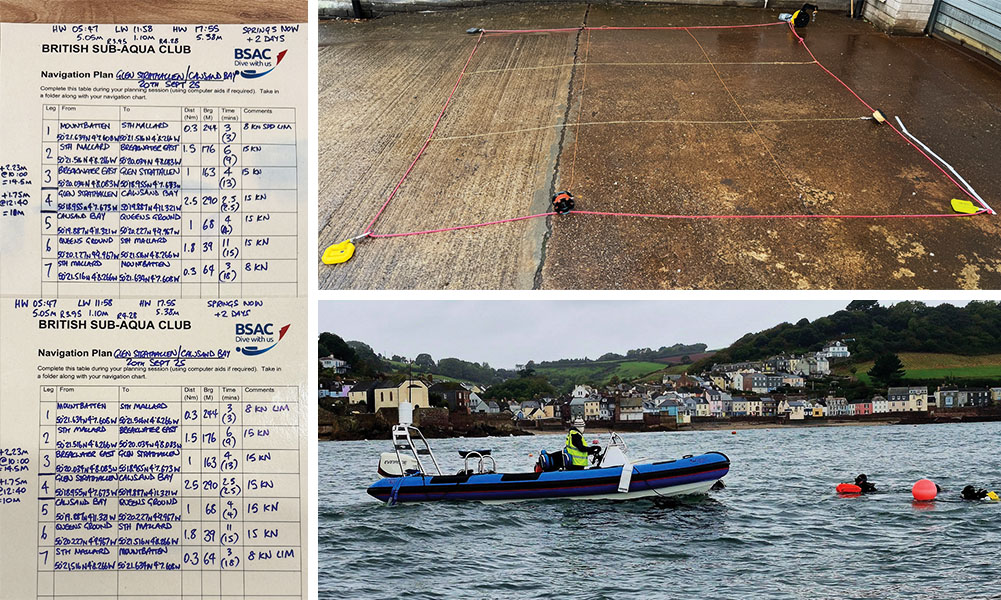
Left: The passage plan | Top: The glamour of a 3x3 grid | Bottom: Enjoying Cawsand Bay
That done, we dropped into the water as two buddy pairs with mesh bags full of kit to lay out, and teach the laying out of a 3x3 grid, then conduct a survey. At the bottom of the shot, the visibility was drastically reduced to less than half a metre. Again, we had to ‘overcome and adapt’. Even in poor conditions, the candidates had to work out how to make a lesson work, then give the examiners an opportunity to teach the lesson back to us.
About 20 minutes into the dive, the candidates each split off with an examiner where they had to give an assessment of a lesson at Open Water Instructor level. I had to assess a lesson on mask clearing, and the examiner made the obvious error of not breaking it down into small enough steps. So I corrected it underwater, and then we went back to the 3x3 grid lesson. The viz had got so poor that the touch signals I had taught on dive one came in useful!
We then got some bad news about the ‘seasick’ candidate. In the morning call with the examiner team, they chatted about the symptoms and decided that it would be a good idea to go to the DDRC to get checked out. When they arrived, DDRC quickly diagnosed a vestibular bend and recompression was needed. After a few minutes on oxygen at pressure, the symptoms were relieved, so this confirmed that it was undoubtedly DCI. The course of treatment carried on over the next day with more recompression, and the diver made a full recovery. They had been diving 28% nitrox as air, and had nothing unusual in the dive profile. It goes to show the importance of getting any new symptoms post-dive checked out.
The pressure eases
The next morning, we had the Branch Interview where you get given zero notice of what the branch wants to talk to you about, and are grilled on various subjects, in my case the new Sport 80 system and the Scottish equivalent of DBS checks. Then we had a no-notice ‘Bob’s been taken ill – can you take over his lesson?’ exercise, where we had to take over the teaching of an AED session.
Finally, we had to spend an hour planning a Rescue Workshop, with stations covering different scenarios with the focus of training non-diving emergency services. We ran it on the nearby beach next to the slipway, to the entertainment of passing dog walkers. At this point, the weekend was over and there was a sense of relief as finally the barrage of questions and pressure was over.
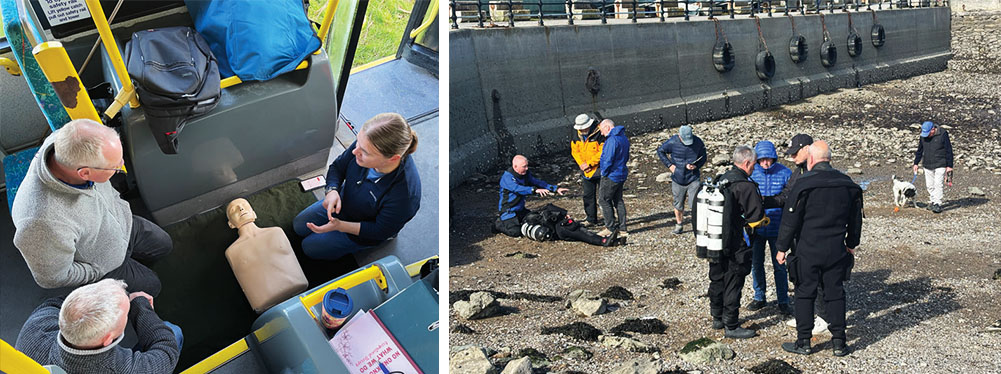
Automated external defibrillator (AED) lesson | The Rescue Workshop
A nervous wait, and three weeks after we left Mountbatten, the results were in. The acid test at this point was “if I fail, would I do it again?” It’s a real test of your diving, teaching and coaching abilities. I have always said that becoming an instructor massively improves your diving skills, becoming an instructor trainer massively improves your instructing skills and now being a National Instructor, this should hopefully massively improve my instructor coaching skills. So yes, I would.
The best thing about the whole experience? Undoubtedly the group of five candidates. The worst? Becoming a group of four at the end of day one.
Become a BSAC member
Want to scuba dive, make friends and have adventures? You can join a club near you!
To get started, find a club and send an enquiry.
This Learning Curve article was originally published in SCUBA magazine, Issue 168, September 2026. For more membership benefits, visit bsac.com/benefits.
Images in this online version may have been substituted from the original images in SCUBA magazine due to usage rights.
 Author: Alex (Woz) Warzynski | Posted 30 Oct 2026